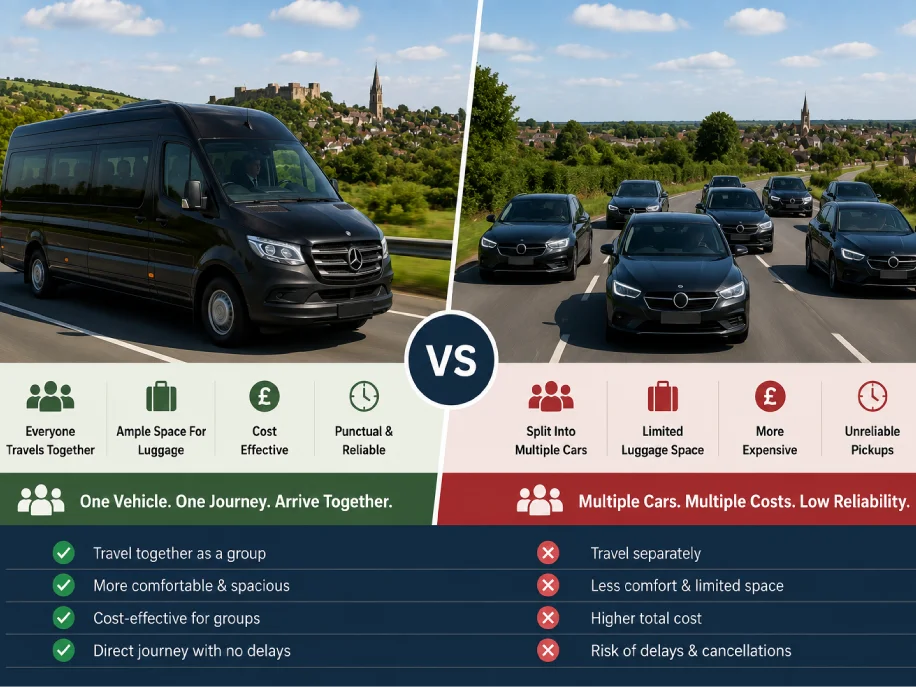
How to ensure you’re booking a safe minibus service?
Kent Minibuses explains what to check before booking a safe minibus in Kent. This guide covers licensing, insurance, MOT history, driver qualifications, and booking terms for airport transfers, corporate travel, and events.
Group travel can fall apart fast. A last minute vehicle swap, an unlicensed driver, or hidden fees can ruin the day.
Booking a safe minibus in Kent means doing a quick due diligence check. Do not treat it as a leap of faith.
This guide from Kent Minibuses shows you what to verify before you pay a deposit. We cover licensing, insurance, MOT history, maintenance, reviews, and booking terms. Follow these steps and you can book with confidence for airport transfers, corporate travel, and events like Royal Ascot.
Key Takeaways for Booking a Safe Minibus in Kent
- Match the trip to the right legal setup. GOV.UK guidance says you usually need a PSV operator’s licence for vehicles carrying 9 or more passengers for hire or reward. Ask about this before you book.
- Licence checks are not optional. Confirm the driver holds a D1 or D entitlement. Ask what proof they can show on the day. DBS checks are common for school style group travel.
- Validate the vehicle, not the sales pitch. Use the GOV.UK MOT history service to check test dates, advisories, and mileage. Then ask for recent servicing records with dates and the garage name.
- Plan for London charges early. Transport for London sets ULEZ standards at Euro 4 for petrol and Euro 6 for diesel for minibuses up to 5 tonnes. A non-compliant vehicle costs £12.50 per day. Build this into your quotes.
- Compare itemised quotes. Providers can look similar at headline price. Insist on a full breakdown and ask what triggers extra fees.
- Know the payment timetable. If terms say 25% deposit now and the balance 30 days before travel, set calendar reminders. Confirm cancellation windows in writing before you pay.
Identify Your Travel Needs Before Booking a Safe Minibus in Kent
Start with a clear brief. The right vehicle and correct licensing both depend on what you actually need.
Write down passenger numbers, luggage volume, and pickup points. Note whether you will enter London. ULEZ and the Congestion Charge affect both routing and cost.
Group Size and Luggage Requirements
UK guidance defines a minibus as a vehicle with 9 to 16 passenger seats, not counting the driver. This definition affects driver entitlement and operator licensing.
You will find 6, 8, 10, 12, 16, 24 and 32 seat options marketed as minibus or coach hire. Focus on what you actually hire. Confirm the exact seat count in writing.
Treat luggage capacity as a first class requirement. A vehicle can fill up long before you run out of seats. This matters most for airport transfers.
- Count real items: large cases, carry ons, buggies, sports kit, and cool boxes.
- Ask where luggage goes: rear boot, internal racks, or a trailer. Check if any seats need folding.
- Check weight limits. Passenger and luggage weight must stay within the manufacturer’s limits. Luggage must stay secured throughout the journey.
- Confirm seatbelts on every seat. Do not assume older vehicles meet current standards, especially for children or mixed age groups.
Kent Minibuses offers vehicles from 8 to 24 seats. We also support coach hire for larger events. Ask us if a standard minibus does not fit your numbers.
When you book, ask for the vehicle make, model, and seat count. Ask whether any seats are removed for luggage or wheelchair access.

Type of Journey: Local or Long Distance
Journey type changes your risk profile. Local trips test timing and pickups. Long distance trips test driver hours, route planning, and contingency.
Hire with a driver suits long distance and unfamiliar routes. You get a professional driver who follows commercial operator processes.
Self drive can work for short local trips. You must verify licence entitlement and insurance carefully. GOV.UK notes that hire or reward rules change depending on whether passengers pay.
| Decision Point | Self Drive Minibus Hire | Minibus Hire with Driver |
| Best for | Short local trips where the driver knows the group | Airport transfers, corporate travel, London runs, and multi-stop event days |
| What you must verify | Driver entitlement, insurance for hired vehicles, hire or reward limits | Driver entitlement, PSV operator licence, insurance, maintenance records |
| Hidden cost risk | Fuel, parking, tolls, and insurance excess add up quickly | Waiting time, extra stops, London charges, and late night extensions can increase the total |
Routes into London need clean air compliance. ULEZ standards for minibuses up to 5 tonnes are Euro 4 for petrol and Euro 6 for diesel. A non-compliant vehicle incurs a £12.50 daily charge.
The Congestion Charge rose to £18 from 2 January 2026. Ask your provider to state whether these charges appear as a line item in your quote.
For luxury minibus hire at events like Wimbledon, Henley Royal Regatta, or the British Grand Prix, check comfort features. Reclining seats, USB charging, and good luggage space all matter on longer legs.
Kent Minibuses covers the whole of the United Kingdom. We serve major seaports including Dover and Southampton and most UK airports. This helps groups that start from different locations.
Research Reputable Minibus Providers in Kent
Do not judge a provider on a star rating alone. Check whether their paperwork matches what a real passenger transport business produces.
When booking a safe minibus in Kent, shortlist three providers. Test each one with the same checklist. This lets you compare quotes on equal terms.
Check Reviews and Customer Ratings
Use Trustpilot and Google reviews to check consistency, not perfection. Look for a pattern of clear communication, punctuality, and good problem handling.
- Filter for recent reviews. Focus on bookings that match yours: airport transfers, sports days, wedding hire, or corporate travel.
- Look for operational detail: driver arrived early, clean vehicle, working seatbelts, help with luggage, smooth multiple pickups.
- Spot repeating complaints: vehicle swaps without notice, unclear waiting time charges, or slow refunds.
- Match the review to your route. London runs and long distance travel have different failure points than local Kent pickups.
Read reviews, note dates and specifics, then choose the provider whose process matches your risk level, not just your budget.
Verify Company Credentials
Before you pay, ask one direct question: do you hold a PSV operator’s licence or a permit? A solid operator answers this without hesitation.
GOV.UK states that operators need a PSV licence for vehicles carrying nine or more passengers for hire or reward. Licence discs go on authorised vehicles and must be visible from outside.
- Ask to see the operator licence: check the name, authorised vehicles, and whether your specific vehicle is listed.
- Confirm the payment structure. The GOV.UK guide notes that private hire uses a single organiser payment. Passengers should not pay separate fares to the operator.
- Check the business details: trading name, invoice address, and company location before you transfer any money.
- Request insurance confirmation: ask for passenger transport insurance that covers your travel date.
If you book through a platform, ask who the actual operator is. Confirm who holds responsibility on the day of travel.
Confirm Safety Standards When Booking a Safe Minibus in Kent
Good operators stand out on safety because they produce evidence fast. They do not hesitate.
Look for two things: a roadworthiness certificate such as an MOT or PCV test, and a documented maintenance culture, not vague promises.
Ensure Vehicles Meet Legal Safety Requirements
Every minibus needs to be roadworthy. An MOT certificate is the standard proof. Some passenger service vehicles carry a PCV test certificate instead.
Seatbelts need attention. Operators often reconfigure minibuses for luggage or wheelchair access. For vehicles first used from 1 October 2001, rules require seatbelts on forward and rearward facing seats, subject to the vehicle’s approval.
- Ask for the date of first use. This helps you ask the right seatbelt questions for that specific vehicle.
- Check every seat. Do not accept a vague statement that most seats have belts.
- Confirm the emergency kit. A first aid kit and fire extinguisher must be present, in date, and easy for the driver to reach.
Ask About Regular Maintenance and Inspections
Ask for a maintenance summary with dates. A serious operator shows servicing records, defect reports, and the next service date.
Run a quick check on GOV.UK MOT history. Enter the registration to see test dates, mileage records, and advisories. Then ask the operator to explain any repeated issues.
- Request the last inspection record: date, mileage, and garage name.
- Ask for daily walkaround check records. Drivers should complete pre journey checks in writing. They must take the vehicle off the road until they fix any faults.
- Ask about GPS tracking and tachograph use. These tools help operators control driver hours and reduce fatigue.
- Confirm loading rules. Luggage must not block passageways or emergency exits. Roof loads can affect vehicle stability.
Evaluate Driver Qualifications
The driver is part of the safety system. You hire judgement under time pressure, not just someone behind a wheel.
Ask the direct questions up front. Record the answers in your booking confirmation.
Verify Licensing and Experience
Drivers need the correct licence entitlement for the vehicle. GOV.UK states that a full D1 or D PCV entitlement covers minibuses for hire or reward. Some licences carry a D1 (101) restriction. This means not for hire or reward.
- Ask for the licence category. D1 or D covers 9 to 16 passenger seats.
- Ask about restriction codes. A not for hire or reward code on D1 means the driver cannot take paid bookings.
- Confirm Driver CPC for professional work. Drivers need CPC for category D1, D1+E, D, or D+E unless an exemption applies.
- Ask for route experience. Look for similar pickup complexity and similar passenger types: corporate groups, wedding guests, or school style travel.
Kent Minibuses builds licence checks into our operator standards. Ask us what we can show you on the day.
Confirm Knowledge of Routes and Safety Protocols
Route knowledge means more than navigation. It covers diversions, safe pickup points, and realistic timing at multi stop locations.
Ask how the driver handles failure points: roadworks, event traffic, and tight drop off windows at London terminals.
- Ask about live traffic tools. Find out who decides to reroute and how fast they act.
- Confirm the pickup plan. Check where the vehicle can legally wait and how waiting time starts.
- Ask about passenger registers for larger groups. A name list stops anyone from being left behind at stops.
- Confirm safeguarding where relevant. For school trips and vulnerable passengers, ask about vetting levels and handover procedures.
Review Booking Terms and Conditions
Clear terms protect your money. A written contract cuts disputes and removes surprise charges.
Read the terms before you pay. Ask the operator to clarify anything unclear in writing.
Cancellation Policies and Refund Options
If the terms require a 25% deposit now and the balance 30 days before travel, add both dates to your calendar straight away.
Check the rules for changing timings, reducing numbers, or cancelling due to illness or event disruption.
- Ask for exact refund cut off dates: when do refunds reduce and when do they stop?
- Confirm the no show rule. Late arrivals at the pickup point can trigger a full charge on some contracts.
- Check substitution rules. Ask what happens if the operator swaps the vehicle and the replacement falls short.
Additional Charges and Fees
Ask for an itemised quote. The base hire cost should sit apart from all variable fees. Hourly rates, daily rates, and event surcharges need their own lines.
Prices rise in peak season and on London event days. Waiting times grow too. Build this into your budget early.
| Fee Type | What to Ask | How to Avoid Surprises |
| Waiting time | When the clock starts and how it rounds | Set a fixed pickup window and a clear meeting point |
| Extra stops and route changes | What counts as an extra stop | List all planned stops in your booking confirmation |
| London road user charges | Whether ULEZ and Congestion Charge are included | Ask for a line item that states included or excluded |
| Parking, drop off fees, and tolls | Who pays and how receipts are handled | Agree a receipts process before travel day |
| Cleaning and damage | What triggers a cleaning fee | Clarify rules for food, drink, and luggage |
| Insurance excess | The excess amount and what it covers | Get the figure in writing and confirm who pays |
If your group plans to drink alcohol, ask for the operator’s written policy before you commit. Some operators ban alcohol on football match runs and similar routes.
Conclusion: Booking a Safe Minibus in Kent
Safe bookings start with simple checks done early. This applies to minibus hire, coach hire, and mixed fleets for weddings.
For booking a safe minibus in Kent, focus on three things first: the operator’s PSV licence, the driver’s entitlement, and clear proof of roadworthiness.
Then compare itemised quotes. Read the booking terms. Confirm how London travel fees and airport transfer costs appear in your invoice.
Do this and you will get a service that runs as planned. Kent Minibuses answers every one of these questions directly. Contact us today for your itemised quote.
FAQ’s
How do I check a minibus service is safe before I book?
Ask for the PSV operator licence, insurance details, and a current MOT or maintenance record. Check the driver holds the right licence category. Confirm seatbelts fit every seat. Verify the vehicle stays within its approved passenger capacity.
Are online reviews enough to trust a minibus company?
Reviews help but should not be your only check. Look for many recent, detailed reviews that match your booking type. Ask for client references if your trip is large or high value.
What documents should a safe minibus operator show me?
Ask for the PSV operator licence, passenger transport insurance, and the MOT or PCV test certificate. Request recent maintenance logs. Check the driver’s licence category and Driver CPC status. Ask for background check evidence if your passengers need it.
What are red flags when booking a minibus in Kent?
Watch for operators who dodge licence or insurance questions. Missing seatbelts, prices well below market rate, and no recent reviews all signal problems. A poor maintenance record is a clear warning sign.
Does Kent Minibuses cover airport transfers and London routes?
Yes. Kent Minibuses serves all major UK airports and seaports including Dover and Southampton. All London route vehicles meet current ULEZ and Congestion Charge standards. We list these charges clearly in every quote.
How far in advance should I book a minibus in Kent?
Book two to four weeks ahead for standard group travel and airport transfers. For peak season trips and events like Royal Ascot or Wimbledon, book four to eight weeks early. Contact Kent Minibuses now to check availability and fix your rate.
MORE POSTS:
Booking transport for a group with young children: Minibus seats and extras